Sunday, March 16, 2014

A CENTENARIAN'S TALE: 1635 Immigrant George Geer (9th GGF)


(GEER/Williams/Button/DeiadamiaThomas-Titus Dort)
Centenarian GEORGE GEER (1635 emigrant from Heavitree, Devon, England) lived to be 105 years old.  (1621-1726)
Old Heavitree Church


Here is his story -be it folklore or fact- handed down through the generations of our Geer family line:
The Geer family of Devon are said to have been wealthy landholders in Heavitree, near Exeter, Devonshire, England.  Upon the death of his father, teen-aged George and his brother Thomas became wards of their uncle who was in charge of their inheritance of considerable property.  
Now here's where the story gets interesting:  to "prepare" for the eventual possession of their inherited property, their dastardly uncle arranged for the two young heirs to 'see the world' and booked their passage to America in 1635 soon after their father's death. Little did they know, however, that it was intended to be a 'one-way-trip' ...to the bottom of the ocean. With a considerable estate within his reach, it appears the uncle needed only to remove 14-year old George and 12-year old Thomas from the equation so as to acquire their tempting inheritance.  To accomplish this task, the uncle wrote to the captain of a ship ready to set sail for America, requesting the boys' passage. George and his brother were given instructions to take the letter to the captain and remain on board until they received a reply.  In his communications with the captain, the boys were to be detained on board as the ship left the harbor, without ability or means to return.  (The devious plot was supposedly meant to include their 'disappearance at sea,' which fortuitously did not occur.)  Imagine their situation as the ship arrived in Boston and two penniless 'castaway' boys disembarked with no friends to meet them and no place to go.  Or so the story goes.  I can just imagine my 9th great grandfather George at the extraordinary age of 105, sitting by the fire retelling this adventure tale to countless wide-eyed great-grandchildren's children.  

The fact remains that George and his brother were orphaned around the time of their passage to America (both mother and father died in, or before, 1635.)  Were they heirs to a fortune, duped by an unscrupulous uncle and left in a foreign country to fend for themselves?  And, if they came from a family of means -and, therefore, opportunity for an education- why did they always sign documents with 'X'?  Until more pieces of the genealogical puzzle are connected, we can only sit back and marvel at this legacy of lore.

Although there are few clues available to detail George and Thomas' first years in America, it is evident by later records that both enjoyed productive lives as first-generation Americans.
The following biographical sketch is from Walter Gear's book, The Geer Genealogy: a historical record of  George and Thomas Geer and their descendants in the United States from 1623 to 1923, published in New York, 1923 (pages 13-15)


WILL OF GEORGE GEER (1621-1726)

In The Name Of God, Amen. June 5, 1723. I, George Geer, of the town of Groton, now residing in Preston, in the County of New London, in the Colony of Connecticut in New England, being weake in body but of perfect mind and memory, thanks be giving unto God for it, calling to mind the mortality of my body, and knowing that it is apinted for all men once to dye, do make and ordain this my last will and testament: That is to say princably, and first of all, I give and recomend my soul into the hands of God that gave it, and my body I recomend to the earth, to be buried in decent Christian burial, at the descretion of my Executors; and as touching such worly estate wherewith it hath pleased God to bless me in this life I give, demise, and dispose of the same in the following manner: Imprimis, I give and bequeath to Sarah, my dearly beloved wife, the use and improvement of one third of my estate during her natural life, and then to be divided among my four daughters, Sarah, Hannah, Margaret and Anne, and my daughter Mary's two daughters, Hannah and Mary, and the rest of my estate I dispose of as followeth: To my son Jonathan five shillings, and to my son Joseph five shillings, and to my son Daniel five shillings, and to my son Robert five shillings and to my son Isaac five shillings, and to my son Jeremiah heirs five shillings, which is their full portion with what they have already had. And to my four daughters, and my two granddaughters, Hannah and Mary Mainer all the rest of my estate of cattle and horse kind, and all the moveable goods, to be equaly devided among my four daughters and two granddaughters, Hannah and Mary Mainer shall have their mother's part. And I hereby make and apoint my love son Robert Geer, and my son-in-law Thomas Gates, full and sole Executors of this my last will and testament; hereby making nul and void all former wills and bequeths, ratifying and confirming this and no other to be my last will and testament. In witness whereof I have set my hand and seal.

GEORGE X GEER.

Thomas Clark 

Stephen Gates

This will was presented for probate Jan. 10, 1726-7, in New London. Amount of Inventory of Personal Estate, £48 19s. 2d. Jonathan Wickwere and Jacob Parke, appraisers.

Wednesday, March 5, 2014

ETCHED IN OLD STONE: Family Names #3 (Z Y & X W)

  • PATERNAL GREAT GRAND UNCLES:  X W and  Z Y  BATES (Bates/Morgan/Glover)
On March 3, 1858, my second great grandfather Andrew Jackson Bates married Elizabeth Cordelia Smith in Doddridge County, Virginia, now West Virginia.  Of their ten children, two sons received the unlikely names of Z Y and X W.  Not initials.  No punctuation. These were their names.  In 1880, Elizabeth died at the early age of 39, leaving behind a 10-month old infant (X W) and his nine siblings:

  • Sevilla, 
  • Jacob Yeater (named after mother's foster father, Rev. Jacob Yeater), 
  • Missouri, 
  • Emma (my great-grandmother), 
  • Milton Underwood* (named after maiden name of mother's foster mother, Ruth Underwood). In 1933 Milton recorded family history based on the life and death of his ancestor, Montey Bates.

  • Byrd (or Bird)
  • Bridget, 
  • Z Y,
  • Ginevra
  • X W (aka "W") 
X W Bates married Levada Bell Watts in 1898; three years later, "W"s sister Emma Bates Morgan gave birth to my grandmother, Levada Mae Morgan

(*Milton's death certificate reads "Milton Ulysses Grant Bate" as recorded by his brother Z Y. )

Tuesday, March 4, 2014

ETCHED IN OLD STONE: Family Names #2 (Epenetus)

  • EPENETUS Olney, 8th GGF ~ EPENETUS Olney, Jr., 7th GGF
OLNEY/WINSOR/DORT
“Salute Epenetus, my beloved: who is the firstfruits of Asia in Christ.” (Romans 16:5)
St. Albans, Hertfordshire, England
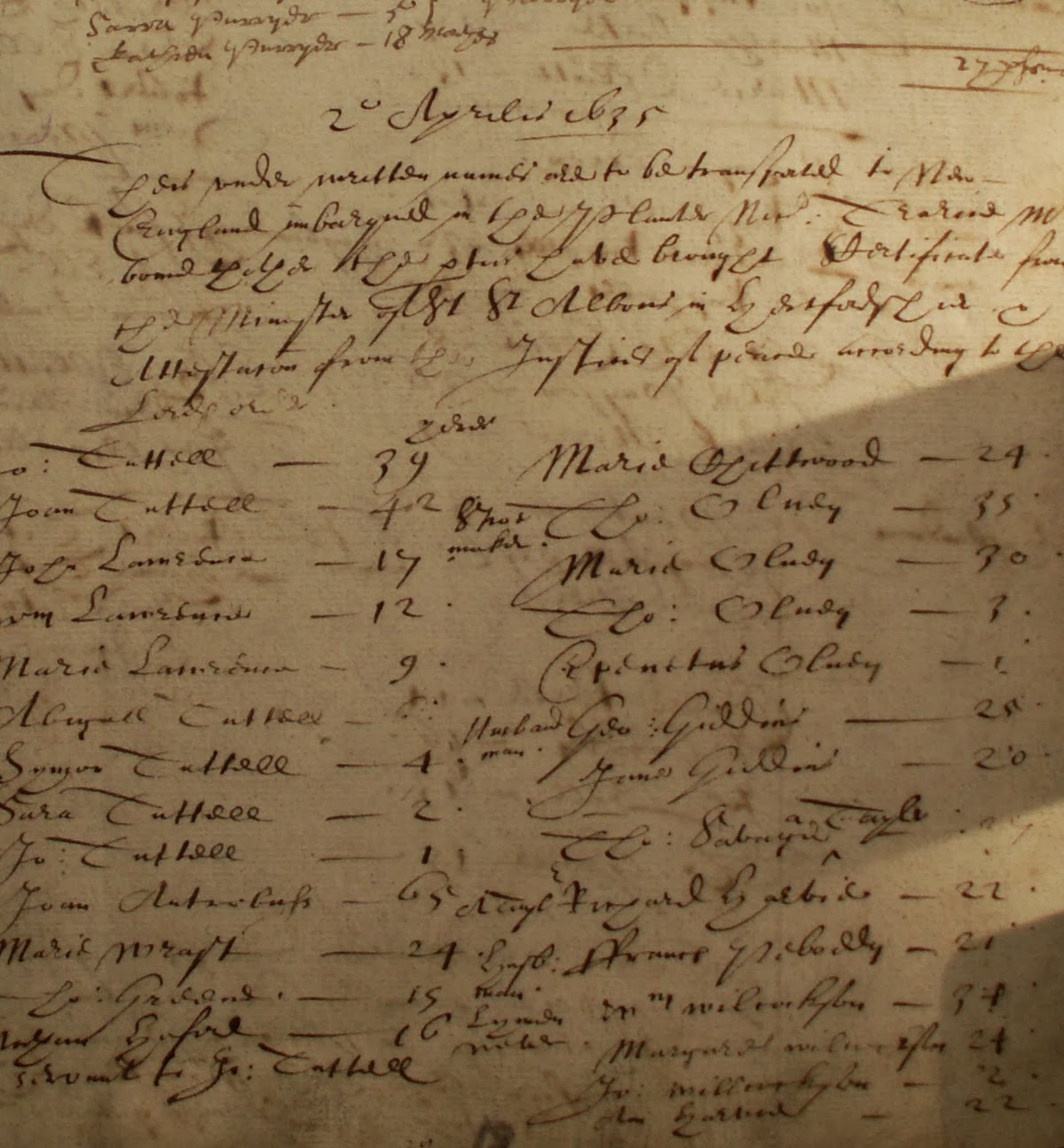
8th GGF Epenetus Olney was baptized in St. Albans, Hertfordshire on 14 February, 1634.  He was only a year old when he emigrated in 1635 from England aboard the ship "Planter" with his parents, Thomas and Mary Olney, and 3-year old  brother, Thomas.  Epenetus' family, like a number of our immigrant ancestors (especially the Dort and Winsor branches) would soon be "invited to leave" Massachusetts colony along with Roger Williams to make their home in Providence, Rhode Island as members of Williams' First Baptist Church.  This is where Epenetus grew up, married Mary Whipple, raised his children, and lived out his life.  Epenetus was a tavern-keeper in Providence, as were the Whipple brothers.

from 1635 Passenger List, "Planter"
 Of interesting note:  Soon after the family's arrival in Massachusetts, EPENETUS had a new American-born brother named DISCOVERED followed two years later by another brother, NEDABIAH.  Although subsequent siblings had the more traditional names of Stephen, James, Mary and Lydia, it appears significant that these given names of Thomas and Mary Olney's children deviated from the standard 'acceptable' names of the time ...something we often see with the Puritan dissenters of the 1630's.  As an additional note, Epenetus had a son named EPENETUS, Jr. (my 7th GGFather) who had a daughter named FREEBORN who married 6th GGFather Joshua Winsor*.  Freeborn had an aunt named FREELOVE Williams, (my 9th GGAunt).
Also interesting: it was not uncommon for siblings of one large family to marry siblings of another. This often creates an interesting family tree where a grandparent is technically an aunt or uncle, too.  Epenetus married Mary Whipple, sister of John Whipple, Jr. who married his sister Mary Olney (my 8th GGAunt through the Olney line AND my 9th GGMother through the Whipple line.)  Their sister Lydia Olney married Joseph, the son of Roger Williams, making them my 10th GGParents through the Roger Williams line.  So my Olney family descends from siblings who represent 8th, 9th, and 10th great-grandparents with pioneer roots in early Rhode Island.
"Stone-Ender-style" Epenetus Olney House, N. Providence, RI

* The WINSOR & DORT family connections
(WINSOR line: Olney/Winsor)
The ancestral families lines of Epenetus Olney and his wife Mary Whipple eventually united with the marriage of Epenetus' GGSon CHARLES WINSOR who married  2nd GGDaughter, MARY WHIPPLE, thus joining the Winsor/Dort families through their son JESSE WINSOR.
Likewise, our ancestral family lineage from Roger Williams sprouts from the marriages of FOUR of his children:
1. (___) JOSEPH WILLIAMS (3rd son of Roger Williams) married LYDIA OLNEY (daughter of Thomas I and sister of Epenetus I)
2. 8th GGM MERCY WILLIAMS (3rd daughter of Roger Williams) married REV. SAMUEL WINSOR (again connecting the two families of Winsor/Dort)
3. 8th GGF DANIEL WILLIAMS (2nd son of Roger Williams) married REBECCA RHODES (daughter of immigrants Zachariah Rhodes and Joanna Arnold)
4. (___) MARY WILLIAMS (1st daughter of Roger Williams) married JOHN SAYLES II  whose daughter Catherine married William Olney (son of Thomas II & brother of Epenetus I)


Tuesday, January 21, 2014

ISHMAEL'S ADVENTURE: 1837 Immigrant Ishmael Smith 2nd GGF


Ishmael Smith's son, Ishmael*

Call me Ishmael.  

Nine-year old Ishmael Smith first set foot on American soil on June 10, 1837. His transatlantic adventure had begun more than five weeks earlier when his parents William and Sarah and his two little sisters, Mary and Betsey, left Lincolnshire, England and boarded the American-owned packet ship, Samson, set to sail from London to New York under the command of Captain Sturgis. 

Although we have no record of the Smith family's voyage other than the ship's manifest, we do have an account of the experiences aboard the Samson by a more privileged passenger who traveled on her a few years later. He contrasted the quality of accommodations provided to those who could afford to travel first-class and those who could not. Of those many immigrant passengers aboard, he noted their fortitude: "...bolstered as they were by the thought that their suffering would not last long, and that the relations on whose invitations they were coming had encountered the same conditions, and now blessed the moment of their decision to emigrate to the happy land." (Augonton Haraszthy's Travels in North America, Utazas Ejszakamerikaban, 1844)
*(Photo is believed to be the son of Ishmael, also named Ishmael, who served as a private in the 7th Cavalry, Co. E, at Fort Ellis, Missouri; Montana Territory. c1877)

cross-section of packet ship

Samson's Swallowtail Lines docking pier NYC "Packet Row"
(NOTE: the passenger list at right shows "labourer" William and Sarah (ages 35 & 30) with their children, ages 9, 5 and 2. Ishmael's name was recorded in error as "Elizabeth" on the line above Mary and Betsey. The four-page list shows that most of the passengers were English skilled tradesmen and laborers.)

The following bio is from History of Detroit and Michigan by Silas Farmer, 1890. "Ishmael Smith, of Denton, Van Buren Township, was born in England, Jan. 10, 1828, came to America in June, 1837, going to Ypsilanti, and moved with his parents to Van Buren in 1842. He remained with his father until 1851, giving his earning toward supporting the family. July 4, 1850, he married Honour Reynolds, of Augusta, Mich. Honour was born in New York, Dec. 27, 1831. In 1856 Ishmael engaged in milling at Denton, and continued until 1887, when he sold the mill to Myron G. Cotton. They have 12 children." (of whom the eldest, William R., is my great grandfather.  Ishmael, the boy immigrant, died in 1903, after almost sixty-six years in America.)

Ishmael's parents: William H. & Sarah (Watts) Smith

 Many thanks to John Colsell for Smith family photos!

Ishmael's Draft Registration Record, June 1863

Sunday, October 27, 2013

THE FALCONER'S DAUGHTER Part 2: Frances Comes to America 10th GGM

DORT-WINSOR/Barker/Dungan-Latham  
FRANCES, "Mother of Governors" 
LATHAM  (10th GGM)
(Illustration from 1932 well-intended 
but uninspiring 'biography' 
of Frances that I purchased and
read, hoping to gain deeper insight into
the life of my immigrant ancestor. Sadly, I did not.
Image courtesy of ancestryimages.com
Very little is known about the woman, Frances.  All that we can learn about her life is in relation to the men she was born to, married, and mothered.
As daughter of Lewis Latham, royal falconer, she carried a portrait of her father to America where it has been passed down through the generations.
As wife of William Dungan, London perfumer, she gave birth to four (or maybe five) children including my 9th GGM, Barbara who was born in 1630 and christened in St. Martin in the Fields parish, Westminster, London.
Upon William's untimely death at the age of 29, this young mother soon married another London merchant, Jeremy Clarke, and in 1637, packed up her family and emigrated to America with him.  Little did she know that this journey destined her to be known centuries later as Rhode Island's "Mother of Governors."
As wife of Jeremy Clarke, Frances had seven additional children of whom one, Walter, would become future colonial governor of Rhode Island.  Their oldest daughter married John Cranston who would also become governor; their son Samuel would serve in that role for thirty years. 
The Clarke's youngest child married another future governor, Caleb Carr.  (James Barker married Frances' daughter Barbara Dungan and later served as a Rhode Island deputy governor.  James and Barbara are my 9th great-grandparents.)
Following her second husband's death in 1652, Frances married once more. Frances' new husband, the Reverend William Vaughn, was one of the original members of the First Baptist Church of Newport, RI, and would soon become the first minister of the Second Baptist Church there.  A poet and distinguished scholar, Vaughn would spend the remaining twenty-one years of his married life with Frances as the spiritual leader of that schism congregation.  (Frances' son, Thomas Dungan studied for the ministry under both Roger Williams and his second step-father, Vaughn.) 
(see inscription below)
 As the widow of an influential Rhode Island statesman and wife of a prominent Newport preacher, we must assume that Frances was well-known and respected by the community in which she lived and raised her large family.  William died in August of 1677 and his wife, the falconer's daughter, outlived him by only weeks. 
As wife, mother and mother-in-law, Frances would be recognized for the legacy of leadership she nurtured including the following list from Wikipedia of governors, deputy governors, or lieutenant governors [who] either descend directly from her, or married one of her descendants:
Governors who are direct descendants:

Deputy or lieutenant governors who are direct descendants:

Governors who are related by marriage:

Deputy governor related by marriage:

  • James Barker, Rhode Island deputy governor 1678-1679  [my 9th GGF, husband of Barbara Dungan and son-in-law of Frances]

‘Of Frances (Latham) Clarke's personal appearance or character, no
word has come down to us through the generations, except in the lives
of such distinguished descendants as few women have given to the world.
Lowell says that every man is a bundle of his ancestors;
of her, we might say that she lives in her descendants.
It is said:
"The hand that rocks the
cradle, rules the world,"
and with the birth and care of her eleven children,
giving them the careful training of those days, besides the keeping of the
home, and entertaining the noted men and women of the times,
her life must have been a very full one.’
"Here Lyeth ye Body of Mrs. Frances Vaughan, Alius Clarke, ye mother of ye only children of Capt'n Jeremiah Clarke. She died ye 1 week in Sept., 1677, in ye 67th year of her age"

THE FALCONER'S DAUGHTER Part 1: Frances Latham, 1637 Immigrant (10th GGM)

 DORT-WINSOR/Barker/Latham (m. Dungan; Clarke; Vaughn)
Shakespeare's writing often alludes to the art of falconry:
 "If I do prove her haggard,
Though that her jesses were my dear heartstrings,
I'd whistle her off and let her down the wind
To prey at fortune."
(Othello 3.3.259-62)
 An adult hawk taken from the wild to be trained for falconry was considered 'haggard' -wild and difficult to subdue even with the restraining leather laces, or 'jesses,' on its legs.
"Forth comming from her darksome mew."  
(Faerie Queene, Book I. Canto v.20) 
The hawks of English royals were kept at the 'mews' of Charing Cross from the time of Richard II and, despite the fact that Henry VIII turned the mews into stables, the falconry term stuck. 

LEWIS LATHAM, falconer to King Charles I, was the father of my 10th great grandmother, Frances Latham Dungan Clarke Vaughn. (Her immigrant story is shared in Part 2.)
Portrait of Lewis Latham
Lewis was born around 1584 in Elstow, a medieval village in Bedfordshire, England, more than 50 miles north of London.
He was trained in the noble art of falconry and became under-falconer to Charles, the Prince of Wales.  When the prince ascended the throne as King Charles I, he retained his falconers and, in 1627, promoted Lewis to King's Sergeant-Falconer. 
Lewis' brother Simon was also a falconer whose book on the subject of falconry "Lathams Falconry, or the Falconers Lure and Cure in two books," gained authority in the field with at least three editions (1615,1633, and 1652.)  
detail from Simon Latham's book on falconry
 

Lewis Latham married Elizabeth*  in 1608 and undoubtedly provided well for a family that included his first-born, Frances, two sons, Henry and John, and four other daughters, Ann, Catharine, Elizabeth, and Ellen -all of whom are mentioned in his will dated 6 May 1653, two years before his death.  [probated in 1655, London] 
According to one Latham family researcher, his widow (*Winifred Downes Latham, possibly 2nd wife) applied for past unpaid salary due her late husband that resulted in an inquiry indicating Latham's original royal courtier fees prior to 1640 were:
King's Falconer - £40 per annum
Sergeant of the Hawks - £65 per annum
Although his widow's efforts were initially unsuccessful, she was eventually awarded about £40 per annum until 1664, presumed to be the year of her death.

Records suggest that Latham may have been a royal falconer at the time of the 'high and mightie prince Henrie, Prince of Wales, older brother to Charles who assumed his brother's title upon Henrie's death in 1612