Showing posts with label Glover/Morgan family. Show all posts

Wednesday, March 6, 2013

LEGACY OF THE WINTHROP WOMAN - Part II "Elizabeth's Neck"


LEGACY OF THE WINTHROP WOMAN - Part II "Elizabeth's Neck"
Elizabeth's Neck, Greenwich Connecticut (circled)
*NOTE: We are related to Elizabeth "Winthrop Woman" Fones and Robert Feake through BOTH sides of the Glover-Smith families.  (Glover/Myers through the Quaker Horner family) (Smith/Emerine through Watson to Townsend.)
On 18 July 1640, all the land between the Asamuck and Potommuck brooks was purchased from area Native Americans for “twentie-five coates.” Now known as Old Greenwich, this property was bought in the name of New Haven Colony by Daniel Patrick, Robert Feake and his wife Elizabeth Fones Winthrop Feake.  
This transaction was recorded in a deed that stated, in part: 
"We Amogerone and Owenoke, Sachems of Asamuck; and Ramatthone, Nawthorne, Sachems of Totomack have sould unto Robert Feakes and Daniell Patricke all their rights and interests in all ye several lands between Asamuck river and Totomack ...except ye neck by ye indians called Monakewaygo, by us Elizabeth Neck, which neck is yet peticaler perchace of Elizabeth Feaks, ye said Robert Feake his wife to be hers and her heaires or assigns forever..." (from The Winthrop Woman, page 409-410)]


According to a professional timeline done for another Greenwich pioneer, Robert Husted, the following supporting facts were recorded:
"July 18, 1640. Robert Husted, and Andrew Messenger witness the main land deed purchase of Greenwich by Daniel Patrick and Robert Feake. Jefery Ferris also received land on this docusment, with Angell Heusted and Richard Williams as witnesses. Elizabeth, the wife of Robert Feake, was given an area of land called Monekewego by the Indians, already named Elizabeth Neck on the document." 
What is now 'Greenwich Point' was originally called ‘Monakewago’ and known for much of the area's early history as 'Elizabeth's Neck' in recognition of its first colonial owner, Elizabeth Feake. 
Since assurance of protection under the New Haven Colony was uncertain and the fact that the Dutch still claimed this region, the early settlers agreed in 1642 to become part of the West India Company’s colony of New Netherland. Greenwich was therefore considered a “manor,” under the local leadership of its “patroons,” Captain Patrick and Robert Feake. Greenwich officially remained a part of the Dutch colony until 1650 with the Treaty of Hartford which placed Greenwich back under the control of New Haven Colony.
It wasn’t long before the lifestyle of Greenwich residents drew criticism from the strict Puritan colonial officials due to complaints that they “live in a disorderly and riotous manner, sell intoxicating liquors to the Indians, receive and harbor servants who have fled their masters, and join persons unlawfully in marriage.”
[This last point likely referred to the scandal of Elizabeth Feake 'marrying' William Hallett without legal divorce from Feake, who had to return to England and left Hallett in charge of his estate. Elizabeth's cousin/brother-in-law Jack Winthrop helped to formalize this situation, despite a child being born prior to official documentation of Elizabeth's 3rd legal marriage, to Hallett.] 
As a consequence, Greenwich was required to become a part of “role model” Stamford. It took years before the General Assembly in Hartford allowed Greenwich to become a separate township known for supplying locally grown produce to packet boats.
[Toby/Tobias Feake, nephew of Robert, was the son of Robert's brother James.  Toby followed Robert to America and piloted his boat "Dolphin" along the coastline between the English and Dutch colonies.  After the death of Daniel Patrick, Toby married his widow, Anneken.]
·
·       

  Photo: Marker located midway down "Elizabeth's Neck"
(Inscription reads: "On July 18, 1640, Daniel Patrick and Robert Feaks landed on these shores in the name of the New Haven Colony to start anew settlement, later called Greenwich. This neck of land is called Elizabeth’s Neck after Mrs. Feaks") 
Related Reading:
http://www.ctgenweb.org/county/cofairfield/pages/greenwich/greenwich_hstry.htm
https://greenwichfreepress.com/around-town/spared-from-the-wrecking-ball-elizabeth-feake-house-was-a-hidden-treasure-under-our-noses-65886/ 
The Winthrop Woman, Anya Seton (1958 historical fiction)

LEGACY OF THE WINTHROP WOMAN -Part I Elizabeth & Robert Feake

FEAKE/BOWNE/HORNER/MYERS/GLOVER
Note sticky tabs...evidence of my detective work on our Feake family line!

Okay, I'll confess... I'm fascinated by the story of Elizabeth and Robert Feake -and the family line they carved out for us in the wilderness of New England & New Netherland. The next few blogs will hopefully shed some light on the indelible marks their family left in the history books of colonial America.

Although author Anya Seton took obvious artistic liberty with her historical novel, she also did her homework carefully.  (Each sticky tab noted in the photo above marks an historical fact that can be followed up from other sources.)  You may think my 'detective work' takes all the fun out of reading but -I assure you- I've had a great time learning about my heritage this way!)

[from my gloversmith ancestry.com file]
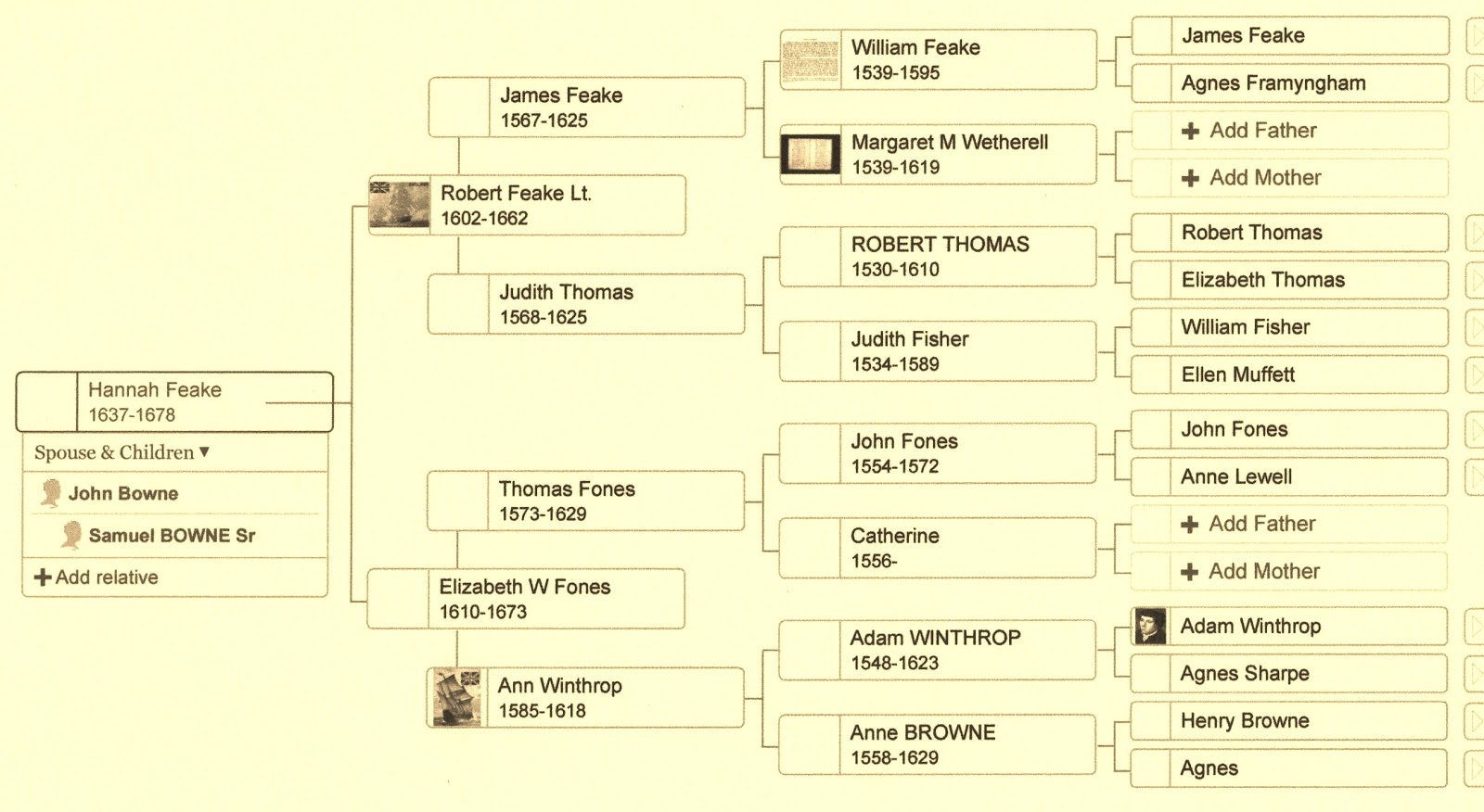
This chart illustrates the family tree of  my 9th great grandmother, Hannah Feake Bowne, daughter through which our "Winthrop Woman" lineage flows.  There is much more to this family's story as I will share in upcoming blogs.

One of the interesting discoveries I made while tracing ancestry was in finding that  Hannah's sister, Elizabeth Feake, also ties into another family connection as the second wife of John Underhill (many years her senior) and their daughter Deborah who married into the Townsend line of the family.

NEXT BLOG:  "Elizabeth's Neck"

Wednesday, February 6, 2013

RAID AT CHUNK'S RUN -Straight/Dragoo

DRAGOO/STRAIGHT/MAYFIELD/SEESE/GLOVER

In most cases, our family branches reach so far back in time that it is difficult to know where to begin to “tell the story”.  And, often, when I build background for that story …it turns into another story …and another… 
Such is the case with the Glover “French Connections.”  Climbing back up the tree along the GLOVER/SEESE branch, I found myself teetering among the generational offshoots to the MAYFIELD/STRAIGHT line that brings us up to what I thought was my destination:  the marriage of JACOB STRAIGHT and ELIZABETH DRAGOO.  And, instead of following the “French Connection” I was originally researching, I realized that this tale of tragedy ending at Chunks Run, (W)Virginia deserved telling first.
Though this story has been told and retold by a number of people, it was typically recorded in the storyteller’s later years in the form of oral history and, as such, tended to take “creative license” with the details.  The core of the tragic tale is revealed through each retelling, however, and we can at least believe that the basic facts remain true.  Below you will find two renditions of this very sad story that may best represent what ultimately happened to the JACOB STRAIGHT family, forever affecting our lives.
The reality is that this family –as many others in our family- lived and died helping to carve a new nation out of the wilderness.  These were dangerous times and, as we learned with the BATES, HUDSON and COON families, our family line continued despite the tragic effects of encroachment on once-held Indian territory.

  • Background on Jacob Straight:
    • Born 23 Jun 1741 Staten Island, New York
    • Married to Elizabeth Ann Dragoo in Marion, Smyth, Virginia
    • By 1780 Jacob Straight and John Dragoo settled on large adjoining farms on Straight Run, now Barrackville, in Maron County, WV
    • Jacob's sister Elizabeth (Betsy) married John Dragoo; John's sister Elizabeth married Jacob
    • Died 3 Oct 1786, age 45; scalped; Chunk Run, Monongalia, (W)Virginia

STORY #1:
MORE SCALPS
This story was told by G.W.T. Anderson (Brother to Elizabeth Anderson Morgan)
Copied by Missouri Morgan Detwyler on November 1, 1928
Copied by Day Bland Detwyler  on November 15, 1951
Copied by Fred Irvin Detwyler III on September 25, 1999
Submitted by Dianne Lowe Lemasters on February 6, 2000

 "As I have passed the seventieth mile stone and am well aware that the sun is getting low in the western horizon; and that the history I know of this section and of the first settler’s, will be lost soon, unless it is preserved in some permanent form by me, I am writing this little sketch.
 Most of this information came direct to me through my mother, Malinda Anderson, formerly Hays, whose father James Hays, was born October 15, 1773 not far from Winchester, VA, and who later came West and settled on Monongahela River not far from Barricksville. This James Hays became acquainted with the Dragoo Family. At this early day the Indians still made raids from the west of the Ohio River to get white scalps and horses from the settlers.
 In 1783, the settlers had not seen any Indians for some time. My mother’s grandmother, Elizabeth Dragoo, and her seven-year-old son ventured out from the fort without guard to their cornfield to pick beans. They remained so long that the people in the fort became alarmed about them and sent out a girl by the name of Straight with my grandmother, also named Elizabeth Dragoo (then 11 years old) to see what was wrong. They went to the field and could see no signs of them. So Grandmother climbed on a stump and hallowed for her mother. Just then the girls became frightened and ran to the fort. At this very moment the Indians had her mother tied to a tree and could hear her child calling her. It is supposed that the reason the Indians did not also take the girls prisoner was that they expected some men to come from the fort and they could get some more scalps. When the alarm was raised at the fort, every man made a dash for the Indians in an attempt to recapture great grandmother and Uncle Billy. On this same night the Indians scalped and tomahawked a man by the name of Jacob Straight and left him for dead. He recovered partially at least and sat on a log and cried. We know this is the truth for he was found dead the next morning by the log and the blood was washed from his face in streaks where the tears run down.
 The Indians made their escape carrying grandmother and her boy. They came up Buffalo Creek and down the North Fork of Fishing Creek to the mouth of what is Betse’s Run. Grandmother was tied on a horse they had stolen. The horse, in jumping over a log, caught and tore the calf of her leg very badly. The Indians stopped and tried to check the flow of blood, but without success. The main band passed on, leaving two Indians with her. Billy understood the purpose was to kill his mother and began crying. One big Indian took the little fellow on his back and told him in English that his mother could not travel or they would not kill her. A few minutes later, the warriors who had remained behind with the woman came running up with her scalp on a tomahawk handle.
 Uncle Billy was taken to the Indian village and remained with them for twenty-three years, marrying a squaw by whom he had four children…two boys and two girls.
 Old Levi Morgan with forty men made a raid on the Indians near the head of the Muskingham River for the purpose of getting Indian prisoners to exchange for the Dragoos. Back home they made canoes near Morgantown to carry all their men. They launched their canoes in the Monongahela River, paddled down past Pittsburgh to the Ohio and on down the river to Marietta and up the Muskingham River as far as their canoes would float. Then they sank them in the bed of the stream and made for the Indian town. When Levi Morgan came to where there were signs of Indians he placed his men behind trees at intervals of fifty yards. Morgan, with my own Grandfather’s brother, Henry Hays, then only 16 years of age, skulked ahead to reconnoiter. Morgan told my Uncle Henry, “Now Henry, when I raise my foot you step right in the track”. Shortly they heard horsed caffing and an Indian speaking to them. They saw the Indian was salting the horses. Morgan whispered to Uncle Henry, “Henry, I will see if I can’t hit him right in the mouth”. He drew his old flintlock and when the gun cracked, the Indian jumped about three feet, gave the warhoop, clapped his hand over his mouth and fell dead. The whole force of Morgan’s men rushed forward to the Indian village capturing some squaws. I do not know how many. They started for their canoes, on their way back to the canoes one of the squaws asked Morgan if they had killed a boy, or seen anything of him. Upon his replying in the negative she advised Morgan to make haste for not over two hours before, fully two hundred warriors had gone out on a hunting expedition.
 They reached their canoes, dumped the water from them, and made their escape without any hindrance, poling and paddling their canoes down the Muskingum and up the Ohio and Monongahela rivers to their homes. Sometime after that a treaty was entered into between the Whites and Indians. The meeting was held near Marietta where prisoners were exchanged. Uncle Billy Dragoo and his two sons were returned to the Whites at this time. They came home and lived with my grandfather, James Hays, who had married Elizabeth Dragoo, the girl who, had gone to hunt for her mother the time the Indians tied her to a tree..."
 STORY #2:
3 Oct 1786 , Straight Run near Barracksville (W) Virginia; In a letter dated 4 Jan 1915 from Adah Marria Eubanks to a Mrs Bredes:
"I can give more in regard to the killing of Jacob Strait by the Indians, which has been given to me by my people.
In the fall of the year, when they were gathering their crops one evening the cattle came running up snorting and bellowing, making a great fuss. Immediately the family became alarmed as they knew from the action of the cattle that the Indians were around. They at once prepared to go to the fort, as that was their only safety. As it began to grow dark and Mrs. Dragoo and her son, who were out in the cornfield gathering beans, did not return to the house, they knew that they had been captured. Jacob Strait and Nicholas Wood went to see if they could get any clue to their whereabouts, till they could get help from the fort. Mrs. Strait and her children had already left the house to go to the fort. It was already dark. Strait and Wood had not gone very far until the Indians had shot Wood from ambush. Strait started to run, but the Indians dodged out in front of him stopping his flight. He held out his hands to them, showing them that he was not armed, and said, 'I mean you no harm, don't kill me and I will go with you.' The Indian gave a grunt - 'Go with me.' and raised the tomahawk and struck him. They then took three scalps from his head. One from the top and one from each side of the back. He had black curley hair. The Indians were selling the scalps to the British. After the Indians left their victim, Mrs. Strait came out of her place of concealment and waded the river to the fort [Pricketts Fort] and gave the alarm.
They returned the next morning and found the Indians had rifled the house of everything in the shape of clothing, even taking the feather beds. Emptying the feathers in the middle of the floor and taking their ticks. They set fire to the feathers, to burn the house no doubt, but they burnt a hole through the floor and the fire went out. They took the body of Mr. Strait and buried it close to where it lay, on the old Strait Homestead, and marked the place, but when the family returned in the spring they could not fnd the place. The winter rains had washed away all the markings.
Mrs. Dragoo could not travel as fast as they wanted to go, so one morning the boy was taken on ahead and told that his mother was ill and not able to travel. Later they told him that his mother had died. The Indians were kind to him. He married a squaw and they had four children, two boys and two girls. When the boys were grown he took them to the woods hunting one day and went on back to Virginia, leaving the two girls with the mother. He afterward married a white woman in Virginia, and lived very happy.
My grandfather, (Jesse B. Straight) was born and raised on the old Strait Homestead, also was my mother (Alcinda M. Straight). My mother, when a child, played hide and seek under the same rock where her great grandmother (Elizabeth) hid when the Indians killed her great grandfather (Jacob Strait), and that rock is still there on the Strait Homestead. Hoping that this will straighten out the mistakes, I will close."

Friday, February 1, 2013

COON'S FORT

MORGAN/BATES/BOOHER/COON
(from History of Harrison Co. VA by Henry Haymond)
“(The Monongalia Story) - Joseph Coon ... is intitled to four hundred acres of land on the waters of West fork adjoining the land of John Tucker to include his Settlement made thereon in the year 1772. Harrison County. Joseph Coon, son of Philip, was born near Philadelphia in 1720, and came here with three of his sons, Anthony, Conrad, and Philip. He supervised the building of Coon's Fort, where his daughter Maudline was killed by the Indians in 1777 (Lough,304-6, 386; Withers 218,219). His land was described as "near the right hand fork of Bingamon Creek on the left hand side as you up to it, including a large bear wallow" (Lough, 261,262)(History of Harrison Co. VA by Henry Haymond)
“The Monongalia Story, VOL I, by Earl L. Core - MARION COUNTY - Fort Coon, Joseph Coon (occasionally spelled Koon) built this small blockhouse to protect the fifty families who had settled in rolling country about four miles upstream from what is now the town of Everson. The stockade consisted of eight small cabins and a large two-storied blockhouse, the latter overlooking Coons Run. It was within a short distance of today's Harrison County line. The fort suffered many attacks, including those which sons, daughters, and grandchildren of the builder were killed. He died in 1798, and is buried near the site of the fort.
“ATTACK AT COON'S FORT - Soon thereafter, according to Withers, two Indians visited the Coon's Fort settlement on the West Fork. Maudline Coon, a daughter of Joseph Coon, "came out for the purpose of lifting some hemp in a field near the fort." While she was thus occupied, two neighbors, Thomas Cunningham and Enoch James, came by, conversed briefly with her, and passed on. Before they had gone far they heard the report of a gun. They looked back just in time to see an Indian run up to the fallen girl and scalp her. The people of the fort turned out in pursuit, but were unable to find the Indians.
“JOSEPH COON DIES - Joseph Coon, of the builders of Coon's Fort (Monongalia Story, vol. I, pp.347,348), died on April 6, 1798, and was buried near the old fort, in Harrison County. A son of Philip Coon, he was born April 4, 1720, near Philadelphia. He married Catherine Cunread and they had seven children, namely, Conrad (1751-1817), married Anne Barbara Stauffer; Joseph Jr. (1752-1830?) married Elizabeth Snyder, then Elizabeth Daniels; Anthony (1755-1835), married Anne Nancy Hellen; Mary, married George Tetrick; Philip (1757-1835?); Elizabeth, married George Smith; and Catherine.” [Catherine is our family link- see below]
OUR COON FAMILY LINE:  (sources for some B/D dates vary and are still under review)
 
JOSEPH COON (1720-1798) married Catherine Cunread (1732-1798)
b. Philadelphia, PA, d. Coon’s Run, Marion, WV  
Joseph is often linked to Philip Kuhn/Coon who immigrated from Germany in 1738.

CATHERINE KOON/COON (17??-1817) married (John) Henry Booher/Booker (1734-18??)
Daughter of Joseph

MARY ANNA BOOHER (1785-1840) married Emanuel (Squire) Bates, Sr. (1785-1820)
Daughter of Catherine

EMANUEL BATES JR. (1813-1881) married Mariah Mathews (1811-1913)
Son of Mary Anna

ANDREW JACKSON BATES (1837-1909) married Elizabeth Cordelia Smith (1841-1880-raised by Rev. J. Yeater)
Son of Emanuel Jr.

EMMA BATES (1865-1933) married William Thomas Morgan (1858-1951)
Daughter of Andrew Jackson

Friday, January 25, 2013

GLOVER FAMILY-from England/Delaware to Glover's Gap


Glover Gap district

The following is quoted directly from a 36 page typescript history prepared by Avril A. Ash and released in 1967.
"John Glover, the progenitor of our branch of the Glover family, emigrated from England to America in 1755 and settled in Wilmington, Delaware. This information is from two sources - (a) 'History of West Virginia,' by Sylvester Myers, a great-great grandson of John Glover, the immigrant, and (b) 'A Genealogy of the Mittong Family and Connections,' by Benjamin Franklin Wilson, who was connected to the Glover family by the marriage of his grandfather, Jacob Mittong (chapter five). Both accounts say he was a young man when he arrived in America, and the year of his birth is placed at about 1735 to 1740. Shortly after his arrival here, he married a girl from New England, name not known, and there were at least two children, Amos and Nehemiah, Amos having been born in 1760 and Nehemiah about 1772. In 1781, which year is questioned on the grounds of Nehemiah being but nine years of age at that time, the two sons came west and settled insouthwestern Pennsylvania, Amos settling in what is now Washington County and Nehemiah in Green County.

(Below:  pages from Wilson's book)

Monday, January 21, 2013

QUAKERS: The Light Within

(photo: George Fox, first Quaker leader)

THE LIGHT WITHIN
QUAKER ancestors from my dad's GLOVER-MYERS branch include the families of: Bowne, Beakes, Stacy, Potts. My mother's  DORT-THOMAS branch include the Quaker families of: Dyer, Hutchinson.   

Let us not forget that many of our ancestors were very early immigrants to the colonies (pre-Mayflower to early 1700).  As such, they often were affiliated with religious practices frowned upon in post-Elizabethan England.  One group, the Society of Friends, has its roots stretching across the Atlantic from England to the American colonies where the “Quakers,” as they were known, sought refuge from religious repression, fines, and imprisonment.

 At that time, the Church of England was the “official” church of the land and, as such, instituted state-mandated religious worship that was highly ritualistic and ceremonial, based on the newly published King James Bible.  The Puritans, dedicated to ‘purifying’ the Church of England, had already been emigrating to Holland and then America to avoid punishment for their form of worship while seeking the freedom of religion they sought. 

 The Quakers (originally a derogatory term they happily adopted) were also targeted as dissenters to the ‘approved’ religion of England.

Thursday, January 17, 2013

LITTLE JACK HORNER

(GLOVER/MYERS/HORNER)
~NURSERY RHYME~
Little Jack Horner sat in the corner
Eating his Christmas pie,
He put in his thumb and pulled out a plum
And said "What a good boy am I!"


According to a number of sources, the rhyme about Little Jack Horner was circulated about 1543 concerning a Thomas Strangeways* Horner. (*wife-Susannah Strangeways) He had acquired the land of the Bishop of Glastonbury, Somersetshire, England, when Henry VIII dissolved the Catholic Church in England and abolished the monasteries from 1536-1539. The deeds for the seized lands were  purportedly secreted in a pie for safe delivery to the King. The metaphoric "plum" was Mells Manor, which Horner plucked for himself from the twelve deeds he was to hand to the King "in the pie". The name "Jack" typically denoted a knave that is a "King's Man" particularly under Henry VIII.
MELLS MANOR/THOMAS HORNER's "Plum"


(My Horner family research goes back to 1573 with the names Thomas and John... and may have direct family connections. I will publish lineage once it is further studied. Either way, I thought you'd enjoy the origins of this nursery rhyme!)

Sunday, January 13, 2013

Who were the ULSTER SCOTS?


Learn more at: 
(a short video about the Ulster Scots),
(an instructional slideshow that provides some interesting
facts)


Tuesday, December 18, 2012

THE SCALPING OF MONTEY BATES

Glover/Morgan Family
Montey Bates & Elizabeth (Crow) Bates history
(Info given by Milton Bates, Center Point, WV, 12/16/1933)


(See corrections below)