Wednesday, June 3, 2015

WHERE THE LILACS ONCE GREW: Union Chapel Cemetery

3GGF TITUS DORT-GGM MAE L. DORT
Union Chapel    Cemetery
Inkster, Michigan
Where the Lilacs Once Grew

Over fifty years ago, my great grandma was buried in a small cemetery only a few miles west of where my Dort 'family tree' was planted in Michigan.  Vermont-born Titus Dort and his brothers Josiah, Calvin, and James came to Michigan from Ohio in 1824 on a cattle drive with their father.*  Two years later, twenty year-old Titus and Josiah, 16, returned to set up a brick manufacturing business.  By 1833 Titus had secured a federal contract to supply the bricks to construct the Detroit Arsenal.** He also began to establish himself as a life-long public servant: Dearborn township school commissioner, township assessor and justice of the peace, leading to  numerous other appointments he accepted throughout his lifetime.  Titus went on to serve in Michigan politics *** as a State Representative (1839, 1842, 1865-66) and State Senator (1849-52).  In 1849 he was chairman of the State Commission of Agriculture, instrumental in establishing the State Agricultural College that soon became Michigan State University -the first U. S. institution of higher learning to teach scientific agriculture.  
Titus and his wife Deiadamia had one son, Andrew Jackson Dort, born 1837 in Dearborn, two weeks before Michigan officially became the nation's 26th state.  With his father busy in civic duties, Andrew ran the family 'market garden' farm.  He married Lydia Secord Winsor and raised a large family including:
-Titus Mortimer
-Jay Wilke
-George Brenton
-Kesiah (Kizzie) Augusta
-Deiadamia (Damia) Pauline
-William Ten Eyck
-Mae Louise and
-Asa J. 
Many of the Dort family are buried at Union Chapel Cemetery -including Titus and his brother Josiah (father of Dallas Dort), Titus' wife, Deiadamia, their son Andrew Jackson and wife Lydia, A. J.'s sons William T. E, infant Asa, and youngest daughter -my great grandmother- Mae Louise.  
While researching my family tree, I discovered that -among all the old graves in the Dort plot- only my great grandma Mae's headstone was unfinished:  the last two digits of her death date had not been incised.  With the helpful assistance of the cemetery caretaker, Delores Murley Bailey, I was able to complete this long-overdue task last month.  Thank you, Delores!

2015 photo courtesy of Julie Hahn
 Established in 1833, Union Chapel Cemetery depends on donations for its upkeep.  In addition to annual placement of Memorial Day graveside flags and regular mowing of the grounds, ongoing maintenance is done to keep the 2-acre property and its many gravesites looking nice.  
 
[2025 UPDATE] 
We appreciate that Delores and her husband provided over thirty years of dedication to this service--and are deeply grateful that their daughter, Roxanne, is continuing their legacy of stewardship!
 
If you are interested in making a contribution to the upkeep of our ancestors' resting place, please contact: Union Chapel Cemetery c/o Roxanne Bailey Kempf, 3508 Stearman Ln., Crawford, Colorado 81415.

* (read Titus' story found in Pioneer Collections "A Personal Reminiscence" p.507)
** (from http://www.motorcities.org/pdf/DearbornTourismGuide.pdf  (c)2013. p 21)  "Construction of the new Detroit Arsenal was completed in 1837.  The complex consisted of 11 buildings enclosed by a wall 12 feet high and 2 1/2 feet thick.  Finally, the new Powder Magazine, located 940 feet east of the Arsenal, was completed in 1839.  Since much of the construction material for the Arsenal was obtained locally, the Arsenal provided jobs for many local residents.  Brick manufacturers, such as Titus Dort eventually constructed a kiln on the Arsenal grounds and produced his bricks on site."

*** (from "Genealogy of the Dart Family In America" by Thaddeus Lincoln Bolton, 1927)
p. 37 "[Titus Dort] served about six terms in the lower house of the Michigan Legislature and about four terms in the Upper House.  He served on the Committee on Agriculture and was responsible in some measure for founding the Agricultural College at Lansing, Mich., and for laying out the plan for organizing the Public Schools of Michigan which has been adopted in large measure in all the other states in the Union.  His farm house stands between Dearborn and Detroit about a mile and a half east of Dearborn, and is owned by Henry Ford..." 

Saturday, May 30, 2015

BLOOD OF FARMERS: Search for Civil War Connections

MORGAN/WILLIAMS -Starkey Connections
Searching for 2GGF Jacob Coleman Morgan
It all began with a black and white photograph of J. Coleman's son, William Thomas Morgan. The image shows William standing next to another man with a typed caption that reads “William T. Morgam & Alf Star---”. The crumpled label obscures the man's last name. He and my great grandfather William stand against a cloth backdrop; both are dressed in suits; William wears a tie and Alf sports a button on his lapel. Although William holds his hands behind his back, they are undoubtedly as work-worn as his companion's. Farmers. They both sport bushy mustaches that are greying; my great grandfather's looks almost white.

But who was Alf? And why were they posed together? I'd have to guess that the photo was taken around the turn of the last century; they appear to be in their early fifties. My curiosity was piqued by the fact that my family tree of over seventy-four hundred people did not include a single surname beginning “Star---”. Until now.

My search for information on my great-great grandfather, Jacob Coleman Morgan has been curiously limited by a scarcity of records. I have an 1850 U.S. Census that lists him as a 17-year old son of James and Athela Morgan. By the 1860 Census, he was listed in Doddridge County as 25 year old husband of L.J. and father of four children. I also found his Civil War draft registration. By the time of the 1870 Census, Jacob's wife had remarried, merging five of their six Morgan children** into the Swiger household.  And, although I have acquired other records, they are probably not for “our” Jacob. (There are at least six Jacob Morgan's in our family tree alone but he seems to be the only Jacob C., and was known as “Coleman.”)

Although my “pre-internet” family tree (based on my father's excellent memory) records Jacob Coleman's death in 1869, modern technology now provides huge archives of information to aid in the refinement of facts that were originally passed down as inter-generational oral history. Data now suggests that my great-great grandfather most likely died sometime between the autumn of 1862 (when his youngest child was conceived) and the autumn of 1865 (when his widow Louisa Jane remarried widower Absalom “Abb” Swiger). And, although it appears that he died during the time of the Civil War, I have not been able to find any verifiable record of military service for Jacob C. Morgan. Or, for that matter, any family stories about him.

My great grandfather William Thomas Morgan would have known his father's story. He may even have passed it on to his grandson, my father Thomas Morgan Glover. But family oral history is often silent on stories difficult to tell. Some family stories were destined to be passed on, others were not. Jacob Coleman's story may have been one of the latter.

While searching for information on Jacob Coleman, I found what appeared to be an unrelated story of three young soldiers named Starkey. There was no mention of J. Coleman, but their story was intriguing ...especially by the fact that their surname started with “Star---” as in the photograph. I still don't know why their Civil War story emerged during this specific search for my great-great grandfather, but it provided the lead to expand my Morgan family line a little more in search of any Starkey connections within it. And there were.

The Morgan-Starkey Connections:
The Morgans are related to the Starkeys through the family of LEVI, SR. and MARY REBECCA (MERRICK) STARKEY. Three of their sons, Samuel, Levi W. F., and Charles were, in turn, the fathers of the three Starkey cousins of the Civil War story I found. (Just to keep family gatherings interesting, all three men also had sons named Samuel, Levi, and Charles.) Our Morgan/Williams family connects through two of LEVI, SR.'s sons:
  • Samuel (born 1791), whose daughter Matilda married Isaac Williams -the uncle of Louisa Jane, wife of Jacob Coleman Morgan. Matilda's brother John T. Starkey was one of the three Starkey Civil War cousins. This means that John T. was the brother of Louisa Jane's aunt.
  • Levi W. F. (born 1806), who married J. Coleman's aunt, Sarah Jane (Price), sister of his mother Athela (Price) Morgan. His son Levi W. was a first cousin to J. Coleman and the second of the three Starkey Civil War cousins.
  • [The third brother, Charles (born 1803) was the father of the third cousin, Curtis Merrick Starkey.]
The Civil War story of these three Starkey cousins is detailed in an excellent online essay entitled “The Blood of Farmers” written in 1997 by Randy Starkey. This carefully researched and tragic story is well worth reading in its entirety at: http://www.rootsweb.ancestry.com/~wvwetzel/Starkey.htm .

According to Mr. Starkey's research,
Private Curtis M. Starkey, wounded in the wilderness, died of his wounds, in a Washington D.C. hospital on June 10, 1864. His body is buried in Arlington National Cemetery, Section 27, Grave #533 in Arlington, Virginia.
Private Levi W. Starkey was treated and later released to return to his home in Marion County, West Virginia. He lived in that county for twenty five more years and later served as school commissioner in Mannington. He moved to Steubenville, Ohio in 1889 and died near there in 1903. It was reported he ultimately died from his battle wound. He is buried in Steubenville.
Private John T. Starkey was treated in a hospital in Washington D.C. He was granted a recuperative furlough in June 1864, to return in July 1864. He went home to his farm in Wetzel County, West Virginia. He failed to return from furlough. His official statement was that he had been too ill to return as required since he was being treated for pneumonia. The army, desperate for troops and unsympathetic, tracked him down. He was arrested at his farm on January 9, 1865, by Deputy United States Marshal Jesse T. Snodgrass. He was taken first to Wheeling, West Virginia, and then to Cumberland, Maryland, on January 12th. He was tried by General Court Martial, for desertion, on February 27, 1865, and found guilty. He was sentenced to be returned to his unit, under guard; to make up all time lost; and to forfeit ten dollars per month, of his private’s pay of thirteen dollars, for a period of twelve months.” (from “The Blood of Farmers,” Randy Starkey, 1997)
NOTE: John T. Starkey was also the father of Alpheus “Alf Star---” Starkey pictured in the photograph with William T. Morgan, “almost” second cousins. Both men were born around 1858 -Alf in Wetzel County, William in neighboring Doddridge County, in soon-to-be West Virginia. Both were eldest sons of farmers and would become farmers themselves. They both would have known their fathers' stories.

We may never know the full story of William T.'s father, J. Coleman Morgan. In a nation where our liberties were once defended in the farmers' fields, the hero's story has always been the one we yearn to hear. But the bloody realities of the Civil War yielded more heartaches than heroics for the men who had to lay down the plow and shoulder the rifle, leaving behind their young families and unplanted crops to defend a fractious national unity with the "Blood of Farmers.”

**[NOTE:  after publishing this post I was able to look back in the Doddridge County census records to find more Jacob C. and Louisa J. Morgan family information.  
In 1860, Jacob and Louisa were both listed as age 25 with the following children:  J.A. (male, age 5), S.A. (female, age 4), M.A. (female, age 3), and W.J. (male, age 2). 
By the 1870 census, widowed Louisa Jane had married Absalom Swiger and the Morgan children in their household were:  Sarah A., 14; Martha A., 13; William T., 11; Mary J., 9; and Caroline M. 6. -aka Amanda C.]

Saturday, May 2, 2015

ANCESTRY: The Reverberating Bell of Ages

In a recent episode of "Who Do You Think You Are," musician Melissa Etheridge stated:   
...I was instantly warmed and moved by the story...
and of course the father/daughter relation always rings a beautiful bell in me,
and how that reverberates on down for generations...
~
I have a strong belief that the influence of your ancestors,
that influence of their journeys, of their adventures, of their thoughts, of their dreams
are handed down through traditions, through ways that we don't even know.
I can't wait to tell [my children] the journey and the things I have learned.” (TLC 2015)

Many of us who study family history are drawn by that 'reverberating bell of ages' that resonates between the past and the present as we discover the people, traditions, and circumstances of our ancestry.  And, as we follow the sound, we strive to imagine what hopes and dreams inspired our kin -guiding them along the unique paths upon which their lives led from their ancestors to us and on to our children; of  a continuous life line of journeys marked by the ancient ring of a beautiful bell sounding its lingering story of family.

Friday, April 17, 2015

Our Quaker Roots #4: LYDIA WRIGHT ON TRIAL

8GGM Lydia Wright Horner (1655-1713) Quaker daughter of 1635 immigrant, Peter Wright (known as founder of Oyster Bay, Long Island, New York) and wife of Quaker Isaac Horner (who emigrated from Yorkshire, England around 1677)
 
1661 Petition
"Some Considerations presented unto the King of England, & C. being Partly an Answer unto a petition and Addresse of the Gen. Court of Boston in New-England, Presented unto the King (As Is Said) Feb. Last, the 11th Day." [Edward Burrough, 1661]

Following the 1661 publication and delivery of this document to England's King Charles II detailing the religious intolerance and persecution of Quakers by Puritan law, England stopped Massachusetts courts from executing any more Quakers for professing their faith.  It did not, however, prevent Massachusetts from continuing to deal out harsh punishments instead.  The execution of Mary Dyer that year particularly sparked a passionate response from many Quakers -especially women.  Three of these women were sisters, Mary, Hannah, and my 8th great grandmother, Lydia Wright, daughters of 1635 English immigrants Peter and Alice Wright of Oyster Bay, Long Island.  
On Sunday, July 8, 1677 Lydia and other Friends silently accompanied Margaret Brewster into Boston's South Church during the service to protest current laws that punished Quakers for not conforming to Puritan religious practices.  Margaret, it should be noted, was dramatically dressed in sackcloth that day as a barefoot penitent with her hair down around her shoulders, ashes upon her head, and her face blackened. Needless to say, her wordless visual testimony had its intentionally disruptive effect and, as a result, she and her entourage were immediately arrested and placed in prison where they remained until their hearing the following month.  Lydia was twenty two years old. Here is the transcript as shown in the records of the Boston Court, August 4, 1677.
Clerk. Call Lydia Wright of Long-Island.
L. Wright. Here.
Gov. Are you one of the Women that came in with this Woman into Mr. Thatcher's Meeting-house to disturb him at his Worship?
L. W. I was; but I disturbed none, for I came in peaceably, and spake not a Word to Man, Woman, or Child.
Gov. What came you for then?
L. W. Have you not made a Law that we should come to your Meeting? For we were peaceably met together at our own Meeting-house, and some of your Constables came in, and haled some of our Friends out, and said, This is not a Place for you to worship God in. Then we asked him, Where we should worship God? Then they said, We must come to your publick Worship. And upon the First-day [Sunday] following I had something upon my Heart to come to your publick Worship, when we came in peaceably, and spake not a Word, yet we were haled to Prison, and there have been kept near a Month.
S. Broadstreet. Did you come there to hear the Word?
L. W. If the Word of God was there, I was ready to hear it.
Gov. Did your Parents give Consent you should come thither?
L. W. Yes, my Mother did.
Gov. Shew it.
L. W. If you will stay till I can send Home, I will engage to get from under my Mother's Hand, that she gave her Consent.
Juggins, a Magistrate, said, You are led by the Spirit of the Devil, to ramble up and down the Country, like Whores and Rogues a Cater-wawling.
L. W. Such Words do not become those who call themselves Christians, for they that sit to judge for God in Matters of Conscience, ought to be sober and serious, for Sobriety becomes the People of God, for these are a weighty and ponderous People.
Gov. Did you own this Woman?
L. W. I own her, and have Unity with her, and I do believe so have all the faithful Servants of the Lord, for I know the Power and Presence of the Lord was with us.
Juggins. You are mistaken: You do not know the Power of God; you are led by the Spirit and Light within you, which is of the Devil: There is but one God, and you do not worship that God which we worship.
L. W. I believe thou speakest Truth, for if you worshipped that God which we worship, you would not persecute his People, for we worship the God of Abraham, Isaac, and Jacob, and the same God that Daniel worshipped.
So they cried, Take her away.
Following the hearings, the court clerk read the governor's sentence as required by the 1661 "more humane" law*:
~Margaret Brewster was to be tied to a cart's-tail at the South meeting-house, stripped to the waist and drawn through the town to receive twenty lashes across her bare body.
~Lydia and the two other women were to be tied to the cart, too. 
In the words of Joseph Besse, author of a 1753 book documenting the deplorable plight of 17th century Quakers:
"During the Examination of these Women, they appeared altogether unconcerned as to themselves, being fully resigned to whatsoever Sufferings might be their Portion; stedfastly maintaining their full Assurance of a divine Call to the Service they went upon, and a perfect Peace and Serenity of Mind in yielding Obedience thereunto:  In all which they seem to have really exercised the Faith and Patience of the Saints and People of God." (Joseph Besse, ``A Collection of the Sufferings of the People Called Quakers''; Vol. II (Chapter V: New England )
Note:  Lydia returned to Oyster Bay but was drawn to the colony of Barbados where Margaret Brewster lived.  She was granted a traveler's certificate by the Society of Friends Quarterly Meeting at Flushing, Long Island on 30th day of the 10th month [Dec.], 1682 that read:
...Friends at Barbadoes, Antigoe, Nevis, Jamaica ... where this may come greeting, whereas, the bearer hereof, our deare friend, Lydia Wright, hath ...time had drawings and moveings on her heart, and minde in ye love of God to visit the seed of God in those parts, and now finding freedom in his love, hath signified ye same unto consideration of this our men and women's Quarterly meeting, we, after a weighty consideration and examination of matters, in God's feare, for ye preservation and exaltation of God'struth, both in particular and in generall, we, with unanimous consent, did and doe aquiess with ye motion of her going to visit friends in your parts, as having good unity therein and therewith; moreover, yt she is one yt hath walked as becometh truth ever since her convincement, according to our knowledge ---- have not heard to ye contrary but has lived in unity with us, and we with her in ye truth. In which truth, that never changeth, we recommend this our deare friend and sister unto you, hoping and desiring your godly care over her, who are your brethren and sisters in ye same truth.
This lovingly written certificate was signed by over twenty members including her sisters Mary and Hannah, both of whom had also been imprisoned years earlier for witnessing their faith.  The meeting secretary's name headed the list:  Isaac Horner.  Lydia returned from Barbados to marry Isaac on 17th March, 1683/4.  Following the birth of their first child in 1685, Lydia and Isaac moved along with Mary and her husband to New Jersey, where the Horner family tree took root.  Sadly, Lydia's sister Hannah  drown on a missionary trip when a boat overturned on the western shore of Maryland.
*See Whittier's poem "The King's Missive"  in which the last Quaker condemned to death and twenty-seven other Quakers were released from prison:
 ..."So the door of the jail was open cast,
And, like Daniel, out of the lion's den
Tender youth and girlhood passed,
With age-bowed women and gray-locked men.
And the voice of one appointed to die
Was lifted in praise and thanks on high,
And the little maid from New Netherlands
Kissed, in her joy, the doomed man's hands."
 Both Mary and Hannah Wright of Long Island (in NY, then New Netherlands) were among the 27 Quakers released that day in 1661, with Hannah only fifteen or sixteen years old.  Since the poet was given facts from the case as background for writing this poem, it seems likely that the "little maid from New Netherlands" represented young Hannah, known as 'The Devotee'.

Tuesday, April 7, 2015

Our Quaker Roots #3: The Manumitter NATHAN BEAKES, Jr.


NATHAN BEAKES, Jr. 1760-1831 (nephew of 7th GGMother Sarah Beakes Potts)  grandson of 1683 immigrant William Beakes, Jr. and great grandson of immigrants Mahlon Stacy and William Beakes, Sr.


"Oh, make Thou us, through centuries long,
In peace secure, in justice strong;
Around our gift of freedom draw
The safeguards of Thy righteous law
And, cast in some diviner mould,
Let the new cycle shame the old!"
(John Greenleaf Whittier, v.6 of "Centennial Hymn")
With the signature shown above, Nathan Beakes Jr. legally manumitted a slave in his household on 30th December 1793.  The handwritten New Jersey document reads:
"I Nathan Beakes of the Township of Trenton in the County of Hunterdon* do hereby certify that I have manumitted and set free and by these presents do manumit and set free my Negro Slave named Caesar, discharging him from all further services to me as a slave.  In witness whereof I have [  ] set my hand & seal this thirtieth Day of December one thousand seven Hundred and ninety three ~ Nathan Beakes  ...Sealed and delivered in the presence of  [two signatures]"
* (Hunterdon County was founded in 1714, from northern part of West Jersey, including part of Burlington County)
As a fourth-generation Quaker, cousin Nathan was part of an early American movement to abolish slavery that began at the table of another ancestor, Thones Kunders over a century before.   After the Revolutionary War, New Jersey passed legislation called "An Act to prevent the Importation of Slaves into the State of New Jersey, and to authorize the Manumission of them under certain Restrictions, and to prevent the Abuse of Slaves,"
This 1786 state law was seen as a victory for the abolitionist movement and set in motion a process that allowed slave-holders like Nathan a legal right to free his slaves under certain conditions, which he met by this additional document that states:
from the New Jersey State Archives
"Hunterdon County [  ]  We do hereby certify, that on this thirtieth Day of December in the year of our Lord one thousand seven Hundred and ninety three Nathan Beakes of the Township of Trenton in the said County of Hunterdon brought before us two of the overseers of the poor of [  ] said Township and two of the Justices of the Peace of the said County, his slave named Caesar, who on view and Examination appears to us to be sound in mind, and not under any bodily Incapacity of attaining a Support, and also is not under twenty-one years of Age nor above thirty five:  In witness whereof we have hereunto set our Hands the thirtieth day of December one Thousand Seven hundred and ninety three  (Overseers of the Poor of the Township of Trenton:  Jos. Brimley, James B. Nachett) and (Justices of the Peace of the County of Hunterdon:  Jas. Simm, [  ?  ]"
Only five years later, the law was repealed to raise the upper age for legal manumission to forty years.  In 1804 new laws were passed to further define New Jersey's plan for "Gradual Abolition of Slavery" and then were repealed in 1820 but continued the manumission process which required that children of slaves born after the 4th of July 1804 were declared "free" but bound as servants to the owners of their mothers for a period of twenty-five years* for males and twenty-one years for females. In the 1830 Hunterdon County Federal Census, the household of Nathan Beakes is listed:
Free White Persons -Males- 30 thru 39: 1 (possibly Nathan's son Morgan, age 35)
Free White Persons -Males- 70 thru 79: 1 (Nathan, age 70)
Free White Persons -Females- 60-69: 1 (his wife Mary [Trent], age 68)
Free Colored Persons -Males- 36-54: 1 (possibly Caesar)
Free Colored Persons -Females- Under 10: 1
Free Colored Persons -Females- 24 thru 35: 1
Slaves -Males- 24 thru 35: 1*
Total Free White Persons: 3
Total Free Colored Persons: 3
~
Nathan Beakes, Jr. died the following year, at which time the one male slave in his household was probably of legal age to be free, as were the rest of the former slaves who remained -as many did- working for their former 'owners.'  
Neither Nathan nor his wife would live long enough to see the end of slavery in New Jersey with the 1846 "Act to Abolish Slavery" or national abolition legislation, the 13th Amendment to the U.S. Constitution in 1865.  The Quaker poet Whittier celebrated the centennial of our nation's freedom with a message of hope and reform for the people of that nation: 
"...Let the new cycle shame the old"


Monday, March 30, 2015

Our Quaker Roots #2: STACY POTTS' HOUSE

6th GGUncle, Stacy Potts, 1731-1816 (brother of 6th GGMother, Mary [Potts] Horner) great-grandchildren of 1678 immigrants Thomas Potts, Sr. and Mahlon Stacy and 1682 immigrant William Beakes
(from trentonhistory.org)

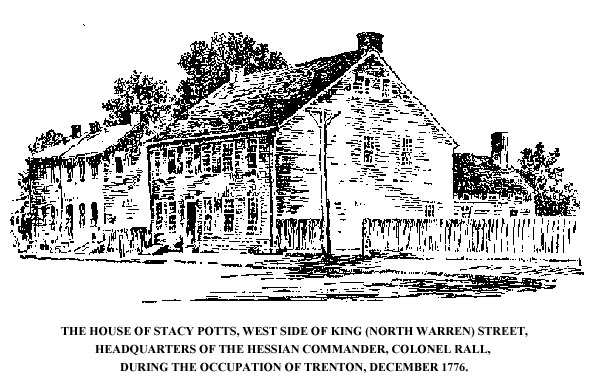
Although the original building is long gone, a plaque marks the site where Stacy Potts lived.  The inscription reads:
"On this site stood the dwelling which was the headquarters of  Colonel Johann Gottlieb Rall, Hessian Commander mortally wounded in the Battle of Trenton December 26, 1776 in which house he died the following day..." 
As George Washington and his troops were  preparing to cross the icy Delaware River, Colonel Rall was supposedly playing checkers with Stacy Potts.  It was the evening of Christmas Day, 1776.  Early the next morning as Washington's troops advanced toward Trenton, the Hessian leader was poorly advised of their progress too late to mount an effective counterattack.  The ensuing battle was brief.  Rall was critically wounded and, upon his death the following day, his remaining Hessian troops laid down their arms.  It was a small, yet morale-building victory for the Americans. (1)
demolished in 1857
A description of Stacy Potts' house:
"Rall's head-quarters. This is a frame building standing upon Warren Street, opposite Perry, near the corner of Bank Alley. The buildings on the left are also of ante-Revolutionary origin. This house was a tavern at the time*, kept by Stacey Potts, the grandfather of Stacey G. and Joseph C. Potts, Esqrs., of Trenton. In a pane of glass, in the front window on the left of the front door, lower story, may be seen a hole made by a bullet, shot during the battle. Colonel Rall died in the front room in the second story, immediately over this window. It is related that a daughter of Mr. Potts, who was at a neighbor's when the firing commenced, was running toward her father's house, when a musket-ball struck her comb from her head and slightly injured her scalp."—Lossing, 1851 (2)  *note: the house did not become a tavern until years later

Fast forward eight years when, as stated on the second part of the historic plaque:
"...The dwelling was from November 30, 1784 to January 5, 1785 the official residence of Richard Henry Lee, President of the Continental Congress then in session in Trenton."

The Jan. 10, 1865 edition of the State Gazette newspaper printed a description of the house providing details of Stacy Potts' property at the time of Lee's occupancy:
"The house is two stories high, spacious and elegant, having three rooms with fireplaces. besides a large dining room with two fireplaces on the lower floor, five rooms on the second floor, a large and convenient kitchen, a cellar under the whole, a pump at the door, a convenient lot with a stream of water running through it and an excellent garden -a stable sufficient to contain eight horses, with room for hay to keep them, may he had with it."  (3) 
This description is significant because, as the official residence of the presiding officer of the Continental Congress, Potts was required to see that his house was appropriately accommodating for such an important member of the first national government of the United States.   Richard Henry Lee of the Virginia House of Burgesses, was elected the sixth President of Congress under the Articles of Confederation on November 30, 1784 at the French Arms Tavern in Trenton, New Jersey. By January, Congress had moved to New York City where Lee served out the remainder of his year in office.  (George Washington, Commander in Chief of the Continental Army and victor of that first Battle of Trenton, became the first President of the United States four years later.)
The text of the lease agreement between Potts and the government was printed in another newspaper article (4) as follows:
THE PRESIDENT’S LEASE. 
This INDENTURE, made this twenty-second day of September, in the year of our Lord one thousand seven hundred and eighty-four, by and between Stacy Potts, of Trenton, in the county of Hunterdon, and State of New Jersey, of the one part, and Moore Furman and James Ewing, Esquires, and Conrad Kotts, all of Trenton aforesaid, for and on behalf of the State of New Jersey of the other part, WITNESSETH that the said Stacy Potts for and in consideration of the rents and covenants herein reserved and contained, to be paid and performed by the said Moore Furman, James Ewing and Conrad Kotts, or by the President of the Congress of the United States of America, for the time being, or any of them HATH demised, granted and to farm let, and by these presents doth devise, grant and to farm let unto them, the said Moore Furman, James Ewing and Conrad Kotts, for the use of the said President of the Congress of the United States, the dwelling house wherein the said Stacy Potts now lives, with the lott of land and garden adjoining thereunto and also the hay house, nearly full of very good hay, with the stables on each side thereof, together with a ten-plate stove belonging to the front part of the said house, the outside of the said house to be well painted at the expense of the said Stacy Potts. To HAVE and to hold the said dwelling house, garden and stables from the thirtieth day of October next, for and during the fall term of one year fully to be compleat and ended, reserving the use of the road as it now goes to the tanyard, and so much of the lott as Samuel Phillips may have occasion for, adjoin his shop. And the said Moore Furman, James Ewing and Conrad Kotts doth covenant, promise and agree to and with the said Stacy Potts, his heirs and assigns, by these presents, that they will paint the inside of the said house and paper as much thereof as may be necessary, and make all such repairs, alterations and amendments to the premises as may be useful and convenient for the said President and his family to be well accommodated, without any trouble or expense to him, the said Stacy Potts, his heirs or assigns. And, also, that they, the said Moore Furman, James Ewing and Conrad Kotts, or the Treassurer of this State, or of the United States, shall pay unto the said Stacy Potts, his heirs or assigns, the sum of one hundred and fifty pounds, in current gold or silver money, in the following manner, that is to say: the sum of fifty pounds on the first day of November next, and the like sum of fifty pounds on the first day of May next, and the remaining fifty pounds at the expiration of the said term, when they, the said Morre Furman, James Ewing and Conrad Kotts engage to surrender and deliver up the said house, lott, garden and stable, with all and every of the appurtenances in good order and repair, unto him the said Stacy Potts, his heirs or assigns; but if any of the alterations made for the accommodation of the said President and his family should not be convenient for the said Stacy Potts, his heirs or assigns, then they the said Moore Furman, James Ewing and Conrad Kotts, shall put that part of the premises into the like condition as they are at this time, without any expense to the said Stacy Potts, his heirs or assigns.
IN WITNESS whereof, the parties aforesaid, hath to these presents interchangeably, set their hands and seals the day above written  Signed and delivered in the presence of JNO. SINGER, JOHN ROZELL. MOORE FURMAN.() JAS. EWING. () CONRAD KOTTS, ()
RECEIPT FOR THE RENT
On the back of the lease is the following endorsement:
Rec’d Feb. 15, 1785, of Moore Furman, Esq., the sum of twenty-five Pounds, being one quarter’s rent for the within Premises to the first day of this month, and they not having made use of the within mentioned Stable or Hay, but suffering the same to remain in my possession, are hereby discharged from the payment of the first payment of fifty Pounds within mentioned. “STACY POTTS.”
The President of Congress occupied the Stacy Potts house during most of the time Congress was in session in this city, residing there only thirty-seven days. 
Richard Henry Lee
Note:   Only a decade earlier, delegate Lee made the important historical motion to the First Continental Congress to declare Independence from Great Britain which includes the following: “Resolved: That these United Colonies are, and of right out to be, free and independent States, that they are absolved from all allegiance to the British Crown, and that all political connection between them and the State of Great Britain is, and ought to be, totally dissolved.” The resulting document, The Declaration of Independence, includes his signature. 
(Lee Portrait: Ann Fletcher 1927 version of original by Charles Willson Peale 1784)
Sources:
 (1) image credit: engraving by Benson J. Lossing, 1850, depicting the dying Rall reclining, his servant, Stacy Potts & wife, Generals Washington and Green, based on original by Flagg
(2) Benson John Lossing, ed. Harper's Encyclopedia of United States History (vol. 9) New York, NY: Harper and Brothers, 1912 
(4) newspaper source unknown; 1884 article entitled 
"CONGRESS IN TRENTON. WHERE THE PRESIDENT LIVED HERE. Stacy Potts’ residence used by the President One Hundred Years Ago---The Lease of the House—Receipts for Rent."; document supplied for publication by William H Potts, Stacy Potts' grandson.

The Trenton Historical Society has excellent online records of original documents showing Stacy Potts' numerous official transactions as a businessman.  A transcribed portion of a 1769 letter he wrote details his connection with his namesake and great grandfather, Mahlon Stacy.  The letter also provides other family history: http://www.trentonhistory.org/Documents/Manuscript/MS57.html


Friday, March 27, 2015

Our Quaker Roots #1: The HORNER Family Tree

GLOVER-MYERS/Horner-Potts
Immigrant families of 6th GGParents, Isaac Horner III and Mary Potts
In the coming posts, I will share what I'm learning about a branch of our Glover family tree that set its roots in the early Quaker movement of America. 
Although I've already touched on a few of its members (Quakers Mahlon Stacye and John Bowne, and parents of Quakers, Robert Feake and his wife Elizabeth "The Winthrop Woman" Fones) this tree has abundantly more fruit upon its branches. 
The next few articles will focus on some inspirational and courageous individuals I happened upon while researching our Horner Family Tree:
  • STACY POTTS (brother of my 6th GGMother, Mary Potts) whose home was the site of history-making events during the American Revolution era
  • NATHAN BEAKES, Jr. (nephew of my 7th GGMother, Sarah Beakes) who signed his name to a 18th century document that served as a harbinger to the future Abolitionist Movement
  • LYDIA WRIGHT (my 8th GGMother) who bravely dared to protest the Puritan persecution of Quakers, and faithfully accepted the consequences